Core Java| JSP| Servlets| XML| EJB| JEE5| Web Services| J2ME| Glossary| Questions?


Search Tutorials

Latest Questions
Comments
 
EJB directory structure 
 

The tutorial is going to explain the standard directory structure of an EJB application.


EJB directory structure


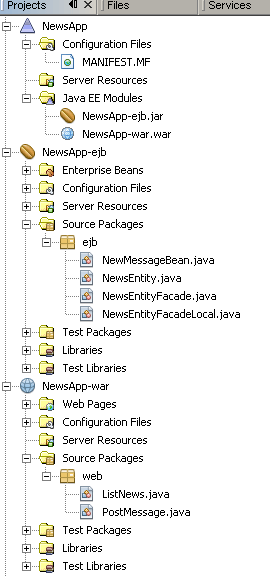
The tutorial is going to explain the standard directory structure of an EJB application . The figure given below is taken of Netbeans IDE. Here in the given figure NewsApp is the application name of the project which we have created. The other files which are created are described below:-

MANIFEST.MF:-This is the file which provides meta-information for the JAR. This file is a standard component of a JAR file. It is used to extend the class path that is being used by the EJB module.

NewsApp-ejb.jar:-This is the jar file which is used for compressing, packaging, and delivering several files together. The use of  the JAR file in EJB is to package all the interfaces and classes that are associated with  beans into one file. This file contain the following files :-

1) XML deployment descriptor
2) bean classes
3) remote and home interfaces
4) primary key class
5) interfaces

NewsApp-war.war:-
This is the file in which we deploy the  ejb remote interfaces and the stub classes .This file includes the EJB client classes

NewsApp-ejb:-This is the EJB module where we have stored beans and interfaces.

NewsApp-war:-This is the web module for our project. Here we have created the servlet and JSP pages.

Figure: EJB Directory Structure in NetBeans

Above given is the standard directory structure of the Enterprise Java Bean application. Just follow the above mentioned steps and test your EJB application using NetBeans.

                         
» View all related tutorials
Related Tags: c database data application io find ejb this app simple tab example to base exam ssi e eps li im

Leave your comment:

Name:

Email:

URL:

Title:

Comments:


Enter Code:

Audio Version
Reload Image
 

Note: Emails will not be visible or used in any way, and are not required. Please keep comments relevant. Any content deemed inappropriate or offensive may be edited and/or deleted.

No HTML code is allowed. Line breaks will be converted automatically. URLs will be auto-linked. Please use BBCode to format your text.

Add This Tutorial To:
  Del.icio.us   Digg   Google   Spurl   Blink   Furl   Simpy   Y! MyWeb 
Training Courses
Tell A Friend
Your Friend Name
Software Solutions
Least Viewed
Most Rated
Recently Viewed
Search Tutorials


Home | JSP | EJB | JDBC | Java Servlets | WAP  | Free JSP Hosting  | Search Engine | News Archive | Jboss 3.0 tutorial | Free Linux CD's | Forum | Blogs

About Us | Advertising On RoseIndia.net  | Site Map

India News

Indian Software Development Company | iPhone Development Company in India | Flex Development Company in India | Java Training Delhi | Java Training at Noida |

Send your comments, Suggestions or Queries regarding this site at roseindia_net@yahoo.com.

Copyright © 2008. All rights reserved.