
Session Beans


What is a Session bean
A session bean is the
enterprise bean that directly interact with the user and contains the business
logic of the enterprise application. A session bean represents a single client
accessing the enterprise application deployed on the server by invoking its
method. An application may contain multiple sessions depending upon the number of
users accessing to the application. A session bean makes an interactive session only
for a single client and shields that client from complexities just by
executing the business task on server side.
For example, whenever a client wants to perform any of these actions such as
making a reservation or validating a credit card, a session bean should be used.
The session bean decides what data is to be modified. Typically, the session
bean uses an entity bean to access or modify data. They implement business
logic, business rules, algorithms, and work flows. Session beans are relatively
short-lived components. The EJB container may destroy a session bean if
its client times out.
A session bean can neither be shared nor can persist (means its value can not be saved to the database) its value. A session bean can have only one client. As long as the client terminates, session bean associated with this client is also terminated and the data associated with this bean is also destroyed.
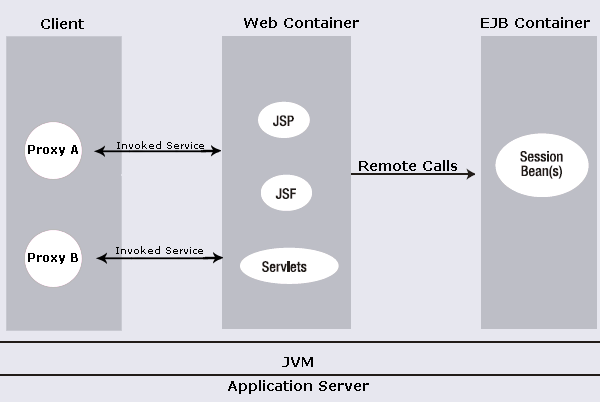 |
The above figure shows how Session Bean interacts with the clients as well as with the Entity Beans.
Session beans are divided into two parts.
- Stateless Session Beans:
A stateless session bean does not maintain a conversational state with the client. When a client invokes the methods of a stateless bean, the instance of bean variables may contain a state specific to that client only for the duration of a method invocation. Once the method is finished, the client-specific state should not be retained i.e. the EJB container destroys a stateless session bean.
These types of session beans do not use the class variables (instance variables). So they do not persist data across method invocation and therefore there is no need to passivates the bean's instance. Because stateless session beans can support multiple clients, they provide the better scalability for applications that require large numbers of clients.
- Stateful Session Beans:
These types of beans use the instance variables that allows the data persistent across method invocation because the instance variables allow persistence of data across method invocation. The client sets the data to these variables which he wants to persist. A stateful session bean retains its state across multiple method invocations made by the same client. If the stateful session bean's state is changed during a method invocation, then that state will be available to the same client on the following invocation. The state of a client bean is retained for the duration of the client-bean session. Once the client removes the bean or terminates, the session ends and the state disappears. Because the client interacts with its bean, this state is often called the conversational state.
For example, consider a customer using a debit card at an ATM machine. The ATM could perform various operations like checking an account balance, transferring funds, or making a withdrawal. These operations could be performed one by one, by the same customer. So the bean needs to keep track its state for each of these operations to the same client.
Thus Stateful session beans has the extra overhead for the server to maintain the state than the stateless session bean.
The user interface calls methods of session beans if the user wants to use the functionality of the session bean. Session beans can call to other session beans and entity beans.
When to use session beans:
Generally session
beans are used in the following circumstances:
- When there is only one client is accessing the beans instance at a given time.
- When the bean is not persistent that means the bean is going to exist no longer.
- The bean is implementing the web services.
Stateful session beans are useful in the following circumstances:
- What the bean wants to holds information about the client across method invocation.
- When the bean works as the mediator between the client and the other component of the application.
- When the bean have to manage the work flow of several other enterprise beans.
Stateless session beans are appropriate in the circumstances illustrated below:
- If the bean does not contain the data for a specific client.
- If there is only one method invocation among all the clients to perform the generic task.
Life Cycle of a Stateless Session Bean:
Since
the Stateless session bean does not passivates across method calls therefore
a stateless session bean includes only two stages. Whether it does not exist or
ready for method invocation. A stateless session bean starts its life cycle when
the client first obtains the reference of the session bean. For this, the container
performs the dependency injection before invoking the annotated @PreConstruct
method if any exists. After invoking the annotated @PreConstruct method the bean
will be ready to invoke its method by the client.
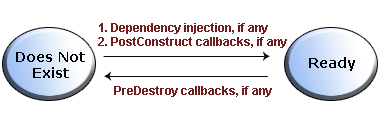
The above figure demonstrates how the Stateless Session Beans are created and destroyed.
The container calls the annotated @PreDestroy method while ending the life cycle of the session bean. After this, the bean is ready for garbage collection.
Life Cycle of a Stateful Session Bean:
A
Stateful session bean starts its life cycle when the client first gets the
reference of a stateful session bean. Before invoking the method annotated @PostConstruct
the container performs any dependency injection after this the
bean is ready. The container may deactivate a bean while in ready state
(Generally the container uses the least recently use algorithm to passivates a
bean). In the passivate mechanism the bean moves from memory to secondary
memory. The container invokes the annotated @PrePassivate method before
passivating the bean. If a client invokes a business method on the passivated
bean then the container invokes the annotated @PostActivate method to let come
the bean in the ready state.
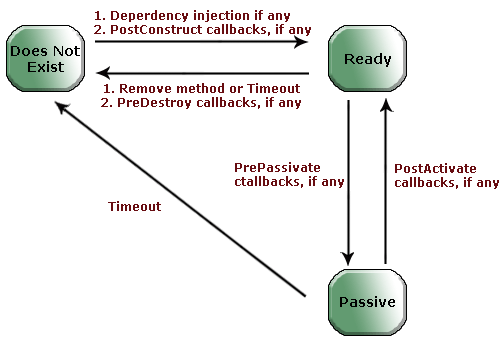 |
The above image shows the various states of the Stateful
Session Beans
While ending the life cycle of the bean, the client calls the annotated @Remove
method after this the container calls the annotated @PreDestroy method which
results in the bean to be ready for the garbage collection.