
Core Java| JSP| Servlets| XML| EJB| JEE5| Web Services| J2ME| Glossary| Questions? | Software Development
 

Get Session Id

In this example we are going to make a program in which we will find the session id which was generated by the container.

Get Session Id


In this example we are going to make a program in which we will find the session id which was generated by the container. 

HttpSession session = request.getSession(); Inside the service method we ask for the session and every thing gets automatically, like the creation of the HttpSession object. There is no need to generate the unique session id. There is  no need to make a new Cookie object. Everything happens automatically behind the scenes. 

As soon as call the method getSession() of the request object a new object of the session gets created by the container and a unique session id generated to maintain the session. This session id is transmitted back to the response object so that whenever the client makes any request then it should also attach the session id with the requsest object so that the container can identify the session. 

The code of the program is given below:

import java.io.*;
import javax.servlet.*;
import javax.servlet.http.*;

public class SessionIdServlet extends HttpServlet{
  protected void doGet(HttpServletRequest request, HttpServletResponse response)
                         throws ServletException, IOException{
    response.setContentType("text/html");
    PrintWriter pw = response.getWriter();
    HttpSession session = request.getSession();
    String id = session.getId();
    pw.println("Session Id is : " + id);
  }
}

web.xml file for this program:

<?xml version="1.0" encoding="ISO-8859-1"?>
<!DOCTYPE web-app
 PUBLIC "-//Sun Microsystems, Inc.//DTD Web Application 2.3//EN"
 "http://java.sun.com/dtd/web-app_2_3.dtd">

<web-app>
 <servlet>
 <servlet-name>Zulfiqar</servlet-name>
 <servlet-class>SessionIdServlet</servlet-class>
 </servlet>
 <servlet-mapping>
 <servlet-name>Zulfiqar</servlet-name>
 <url-pattern>/SessionIdServlet</url-pattern>
 </servlet-mapping>
</web-app>

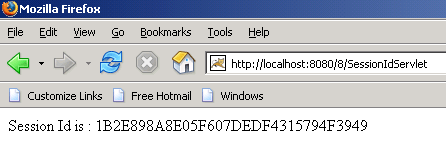
The output of the program is given below:
Download this example:


» View all related tutorials
Related Tags: c http browser class ant process post https methods servlet method sed get type const request constants content value return

Leave your comment:

Name:

Email:

URL:

Title:

Comments:


Enter Code:

Audio Version
Reload Image
 

Note: Emails will not be visible or used in any way, and are not required. Please keep comments relevant. Any content deemed inappropriate or offensive may be edited and/or deleted.

No HTML code is allowed. Line breaks will be converted automatically. URLs will be auto-linked. Please use BBCode to format your text.

Add This Tutorial To:
  Del.icio.us   Digg   Google   Spurl   Blink   Furl   Simpy   Y! MyWeb 

Current Comments

1 comments so far (
post your own) View All Comments Latest 10 Comments:

it is very nice to practice the servelts ...thnx

Posted by veeraravi kumar on Saturday, 07.7.07 @ 12:56pm | #20876

 
Tell A Friend
Your Friend Name


Recently Viewed
Software Solutions
Search Tutorials


Home | JSP | EJB | JDBC | Java Servlets | WAP  | Free JSP Hosting  | Search Engine | News Archive | Jboss 3.0 tutorial | Free Linux CD's | Forum | Blogs

About Us | Advertising On RoseIndia.net  | Site Map

India News

Send your comments, Suggestions or Queries regarding this site at roseindia_net@yahoo.com.

Copyright © 2008. All rights reserved.