
Login Authentication using Bean and Servlet In JSP


In this section, we have developed a web application of login authentication using Bean in JSP. Five files are used "login.jsp", "loginbean.jsp", "welcome.jsp","LoginBean.java" and "login.java" in the code given below.
Brief description of the flow of application :
1). Create a webpage "login.jsp" to login the user.
2). Create a webpage "loginbean.jsp" to set the parameter using JSP Bean and forward to the Servlet page.
3). Create a bean file "LoginBean.java" to mapping the parameter from "loginbean.jsp".
4). Create a Servlet "login.java" to validate the username and password from the database.
5). Create a webpage "welcome.jsp" display a message after successfully user login.
Step:1 Create a web page "login.jsp" to login the user.
<html> <head> </head> <body> <form name="loginform" method="post" action="loginbean.jsp"> <br><br> <table align="center"><tr><td><h2>Login Authentication</h2></td></tr></table> <table width="300px" align="center" style="border:1px solid #000000;background-color:#efefef;"> <tr><td colspan=2></td></tr> <tr><td colspan=2> </td></tr> <tr> <td><b>Login Name</b></td> <td><input type="text" name="userName" value=""></td> </tr> <tr> <td><b>Password</b></td> <td><input type="password" name="password" value=""></td> </tr> <tr> <td></td> <td><input type="submit" name="Submit" value="Submit"></td> </tr> <tr><td colspan=2> </td></tr> </table> </form> </body> </html>
Step:2 To create a "loginbean.jsp"
to set the parameter of the login.
<%@ page language="Java" import="java.sql.*" %>
<HTML>
<HEAD><TITLE>DataBase Search</TITLE></HEAD>
<BODY>
<jsp:useBean id="db" scope="request" class="logbean.LoginBean" >
  <jsp:setProperty name="db" property="userName" value="<%=request.getParameter("userName")%>"/>
  <jsp:setProperty name="db" property="password" value="<%=request.getParameter("password")%>"/>
 </jsp:useBean>
<jsp:forward page="hello">
  <jsp:param name="username" value="<%=db.getUserName()%>" />
  <jsp:param name="password" value="<%=db.getPassword()%>" />
</jsp:forward>
</body>
</html>
Step:3 To create a "LoginBean.java" to mapping the parameter of "loginbean.jsp".
package logbean;
public class LoginBean {
  String userName="";
  String password="";
  public String getUserName() {
  return userName;
  }
  public void setUserName(String userName) {
  this.userName = userName;
  }
  public String getPassword() {
  return password;
  }
  public void setPassword(String password) {
 this.password = password;
  }
  }
Step:4 To create a Servlet "login.java" for validate the user login.
import java.io.*;
import javax.servlet.*;
import javax.servlet.http.*;
import javax.sql.*;
import java.sql.*;
public class login extends HttpServlet{
 public void doPost(HttpServletRequest request, HttpServletResponse response)
   throws ServletException,IOException{
  response.setContentType("text/html");
  PrintWriter out = response.getWriter();
  System.out.println("MySQL Connect Example.");
  Connection conn = null;
  String url = "jdbc:mysql://localhost:3306/";
  String dbName = "user_register";
  String driver = "com.mysql.jdbc.Driver";
  String userName = "root";
  String password = "root";
 String username="";
 String userpass="";
 String strQuery= "";
  Statement st=null;
  ResultSet rs=null;
  HttpSession session = request.getSession(true);
  try {
  Class.forName(driver).newInstance();
  conn = DriverManager.getConnection(url+dbName,userName,password);
  if(request.getParameter("username")!=null &&
     request.getParameter("username")!="" && request.getParameter("password")!=null &&
     request.getParameter("password")!="")
  {
  username = request.getParameter("username").toString();
  userpass = request.getParameter("password").toString();
  strQuery="select * from userregister where
    username='"+username+"' and  password='"+userpass+"'";
 System.out.println(strQuery);
  st = conn.createStatement();
  rs = st.executeQuery(strQuery);
  int count=0;
  while(rs.next())
  {
  session.setAttribute("username",rs.getString(2));
  count++;
  }
  if(count>0)
  {
  response.sendRedirect("welcome.jsp");
  }
  else
  {
 response.sendRedirect("login.jsp");
  }
  }
  else
  {
 response.sendRedirect("login.jsp");
  }
  System.out.println("Connected to the database");
  conn.close();
  System.out.println("Disconnected from database");
  } catch (Exception e) {
  e.printStackTrace();
  }
  }
}
Step :5 To create the webpage "welcome.jsp" to display the message after successful message.
<HTML>
<HEAD><TITLE>Welcome</TITLE></HEAD>
<BODY>
<br><br><br><br>
<table align="center" style="border:1px solid #000000;">
<%
if(session.getAttribute("username")!=null && session.getAttribute("username")!="")
{
String user = session.getAttribute("username").toString();
%>
<tr><td align="center"><h1>Welcome <b><%= user%></b></h1></td></tr>
<%
}
%>
</table>
</body>
<html>
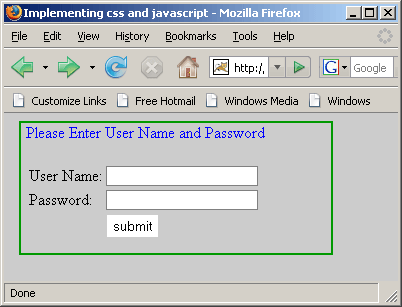
Output:
Login Authentication form :
After Successful Login user :