Core Java| JSP| Servlets| XML| EJB| JEE5| Web Services| J2ME| Glossary| Questions?


Search Tutorials

Latest Questions
Comments
 
The autoFlush Attribute of page Directive In JSP 
 

This section illustrates you about the autoFlush attribute of the page directive in JSP.


The autoFlush Attribute of page Directive In JSP


This section illustrates you about the autoFlush attribute of the page directive in JSP. This is an boolean attribute. This attribute of the page directive supports for flushing buffer automatically when the buffer is full. The value of the autoFlush attribute is either true or false. If you will specify the true value then the buffer will be flushed otherwise it will generate a raised exception if you set the false value. You cannot set the false value if the buffer size is none.

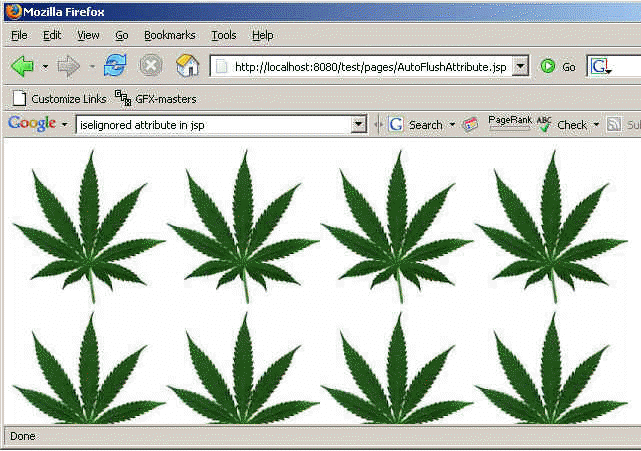
In this section, you will see about the syntaxes of the attribute of the page directive in JSP. In the following JSP code line 1: <%@page buffer="5kb" autoFlush="false" %> is specified for determining the buffer size and permit flushing buffer automatically or not. Hence, the value of the attribute autoFlush is false. So, the page will not be flushed automatically and the output is buffered with at least 8kb size of buffer if you specify the buffer size except none.

Here is the JSP code:

<%@page buffer="5kb" autoFlush="false" %>
<%
	for(int i = 0; i < 10; i++){
		out.println("<html><body><img src=images/
marijuana_leaf.jpg /></body></html>");
	}
%>

Output of the JSP program:

Download this JSP example.


» View all related tutorials
Related Tags: c com orm table ant data join select form make tables tab for to between e ul result pe from

Leave your comment:

Name:

Email:

URL:

Title:

Comments:


Enter Code:

Audio Version
Reload Image
 

Note: Emails will not be visible or used in any way, and are not required. Please keep comments relevant. Any content deemed inappropriate or offensive may be edited and/or deleted.

No HTML code is allowed. Line breaks will be converted automatically. URLs will be auto-linked. Please use BBCode to format your text.

Add This Tutorial To:
  Del.icio.us   Digg   Google   Spurl   Blink   Furl   Simpy   Y! MyWeb 

Current Comments

1 comments so far (
post your own) View All Comments Latest 10 Comments:

I am not getting the difference between two autoFlush example

Posted by taslim on Friday, 08.31.07 @ 17:34pm | #24614

Training Courses
Tell A Friend
Your Friend Name
Software Solutions
Least Viewed
Most Rated
Recently Viewed
Search Tutorials


Home | JSP | EJB | JDBC | Java Servlets | WAP  | Free JSP Hosting  | Search Engine | News Archive | Jboss 3.0 tutorial | Free Linux CD's | Forum | Blogs

About Us | Advertising On RoseIndia.net  | Site Map

India News

Indian Software Development Company | iPhone Development Company in India | Flex Development Company in India | Java Training Delhi | Java Training at Noida |

Send your comments, Suggestions or Queries regarding this site at roseindia_net@yahoo.com.

Copyright © 2008. All rights reserved.