Core Java| JSP| Servlets| XML| EJB| JEE5| Web Services| J2ME| Glossary| Questions?

Hot Searches
struts-config.xml  web.xml  Java date format  read/write text file using javascript  ArrayList  Insert Data into Database Using Hibernat  create text file using java  insert data to text file using java  Visual Basic Date and Time Display the t  Create table and insert data by sql quer 

  JDO Tutorials
  EAI Articles
  Struts Tutorials
  Java Tutorials
  Java Certification
  Java Applet
Questions
Comments

Use of Local Inner class


The Java language enables you to define a class inside another class. Such a class is defined as Nested Class or Local Inner class. The Nested Class are classified into -

1)Static Nested Inner class are declared static called static Nested classes.

2)Non-Static Nested classes are those classes that are not defined static. This class is defined also as Inner class.

The Inner class is defined as local Inner class when you declare a inner class within the body of method.

Understand with Example

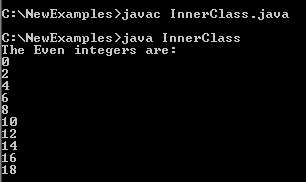
The Tutorial illustrates an example from Local Inner class. The code include a Outer class Inner class include a method that add the integer into the array. The println print the even indices of the array. The inner class Get Even Integer is same as Java iterators,The work of Get Even Integer are used to step through a Inner class, This method  used in GetBig Integer is used to retrieve the last element, the current element and the last element. The main method that instantiate a Inner Class object and this is used to fill the array Of Ints array with the specified value, This call a print even method and print the required even output in ascending order.

Here is the code:

public class InnerClass {
private final static int size = 20;
private int[] arrayOfIntger = new int[size];

public InnerClass() {
for (int i = 0; i < size; i++) {
arrayOfIntger[i= i;
}
}
public void even() {
GetEvenInteger integer = this.new GetEvenInteger();
while (integer.hasNext()) {
System.out.println(integer.getNext() " ");
}
}
private class GetEvenInteger {
private int next = 0;
public boolean hasNext() {
return (next <= size - 1);
}
public int getNext() {
int value = arrayOfIntger[next];
next += 2;
return value;
}
}
public static void main(String args[]) {
InnerClass innerClass = new InnerClass();
System.out.println("The Even integers are: ");
innerClass.even();
}
}

Output will be displayed as:

Download Source Code


Leave your comment:

Name:

Email:

URL:

Title:

Comments:


Enter Code:

Audio Version
Reload Image
 

Note: Emails will not be visible or used in any way, and are not required. Please keep comments relevant. Any content deemed inappropriate or offensive may be edited and/or deleted.

No HTML code is allowed. Line breaks will be converted automatically. URLs will be auto-linked. Please use BBCode to format your text.

Add This Tutorial To:
  Del.icio.us   Digg   Google   Spurl   Blink   Furl   Simpy   Y! MyWeb 
Tell A Friend
Your Friend Name


Home | JSP | EJB | JDBC | Java Servlets | WAP  | Free JSP Hosting  | Search Engine | News Archive | Jboss 3.0 tutorial | Free Linux CD's | Forum | Blogs

About Us | Advertising On RoseIndia.net  | Site Map

India News

Indian Software Development Company | iPhone Development Company in India | Java Training Delhi | Java Training at Noida |

Send your comments, Suggestions or Queries regarding this site at roseindia_net@yahoo.com.

Copyright © 2008. All rights reserved.