Client-Server Architecture


Client-server architecture can be considered
as a network environment that exchanges information between a server
machine and a client machine where server has some resources that can be
shared by different clients.
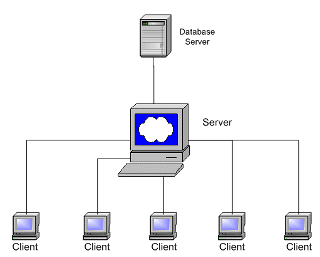
In a Client/server architecture individual
computers (known as clients) are connected to a central computer which is known
as ?server?.
Let?s take an example of a file server to understand the core process of a
client/server network, the file server acts as a storage space on the network
for the files, spreadsheets, databases, etc. Instead of storing these records on
every individual computer, the file server allows the clients to store their
files on one central computer and make them sharable. The client-server
architecture is beneficial in reducing the multiple iterations of a single file
and allowing the organization to have one centralized point for every computer
to access the same file.
 |
The interaction between a lamp and an
electrical socket can be considered as a interaction between client and server
is just like. In the example the electrical socket is just like a server and the
lamp works like a client.