
Collections Framework


Java provides the Collections Framework. In the Collection Framework, a collection represents the group of the objects. And a collection framework is the unified architecture that represent and manipulate collections. The collection framework provides a standard common programming interface to many of the most common abstraction without burdening the programmer with many procedures and interfaces. It provides a system for organizing and handling collections. This framework is based on:
- Interfaces that categorize common collection types.
- Classes which proves implementations of the Interfaces.
- Algorithms which proves data and behaviors need when using collections i.e. search, sort, iterate etc.
Following is the hierarchical representation for the relationship of all four interfaces of the collection framework which illustrates the whole implementation of the framework.
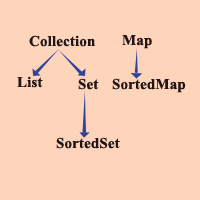
During the designing of a software (application) it need to be remember the following relationship of the four basic interfaces of the framework are as follows:
- The Collection interface which is the collection of objects. That permits the duplication of the value or objects.
- Set is the interface of the collections framework which extends the Collection but forbids duplicates.
- An another interface is the List which also extends the Collection. It allows the duplicates objects on different position because it introduces the positional indexing.
- And Map is also a interface of the collection framework which extends neither Set nor Collection.
Some interfaces and classes of the collection framework are as follows:
| INTERFACES | CLASSES |
| Collection
Interface Iterator Interface Set Interface List Interface ListIterator Interface Map Interface SortedSet Interface SortedMap Interface |
HashSet
Class TreeSet Class ArrayList Class LinkedList Class HashMap Class TreeMap Class Vector Class Stack Class |
Every interfaces and classes are explained next in the roseidia.net java tutorial one by one in the various examples.
Advantage of the Collections Framework:
The collections framework offers developers the following benefits:
- It increases the readability of your collections by providing a standard set of interfaces which has to be used by many programmers in different applications.
- It makes your code more flexible. You can make the code flexible by using many interfaces and classes of the collection framework.
- It offers many specific implementations of the interfaces. It allows you to choose the collection that is most fitting and which offers the highest performance for your purposes.
Interfaces of the collections framework are very easy to use. These interfaces can be transparently substituted to increase the developed application performance.
